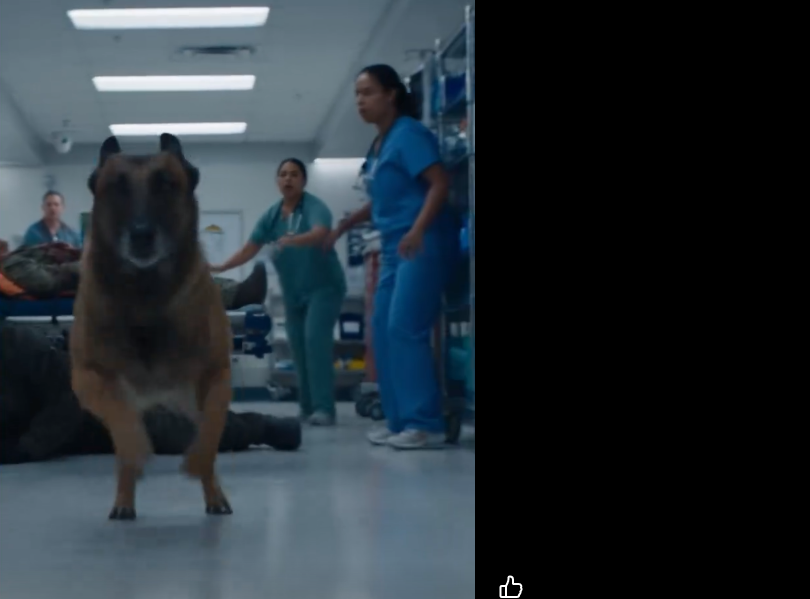
The military working dog broke free from his handler in the middle of a crowded emergency department, and every person in the hallway thought he was about to attack me.
I knew exactly what he was going to do.
That frightened me more than anything.
“ROOK!
DOWN!”
The handler’s command cracked across the emergency department.
A woman screamed.
A security officer reached for his radio.
Two nurses stumbled backward as eighty pounds of Belgian Malinois charged across the polished floor.
I stood perfectly still.
The dog stopped inches from my knees.
For one terrible second, neither of us moved.
Then he sat.
His back straightened.
His ears rose.
Slowly, with the unmistakable precision of an animal performing a command learned years earlier, he lifted his right paw and pressed it against his chest.
The entire hallway fell silent.
I felt something inside me break.
“Hello, soldier,” I whispered.
Rook made a small sound.
Not a growl.
Not a bark.
A trembling, almost helpless whine.
I had heard that sound only once before.
Five years earlier, beneath a collapsing roof on the other side of the world, when his first handler had stopped breathing.
My name is Ava Hale.
Until that morning, I was simply the new emergency department nurse at Garrison Memorial Hospital in Norfolk, Virginia.
My light-blue scrubs still had creases from their packaging.
My identification badge hung crooked against my chest.
AVA HALE, RN.
I had checked it three times before beginning my shift.
There had been a time when my identification included a military service number, blood type, clearance information, and a rank.
Lieutenant.
United States Navy.
Five years earlier, that identity had disappeared during a classified evacuation operation.
My personnel record had been marked missing.
An inquiry had eventually concluded that I was probably dead.
I had spent the following five years making certain no one discovered otherwise.
Until Rook recognized me.
“Ma’am, don’t touch him!”
The handler approached cautiously, one hand extended toward the dog’s collar.
Rook never looked away from me.
“He’s never done this before,” the young sailor said.
I believed him.
Rook had been trained to obey commands under gunfire, explosions, collapsing buildings, and every kind of chaos men could create.
He had once remained motionless beside a wounded teammate while the walls around us shook from incoming fire.
But he had never been trained to forget.
“Rook,” I whispered.
“Easy.”
His ears shifted.