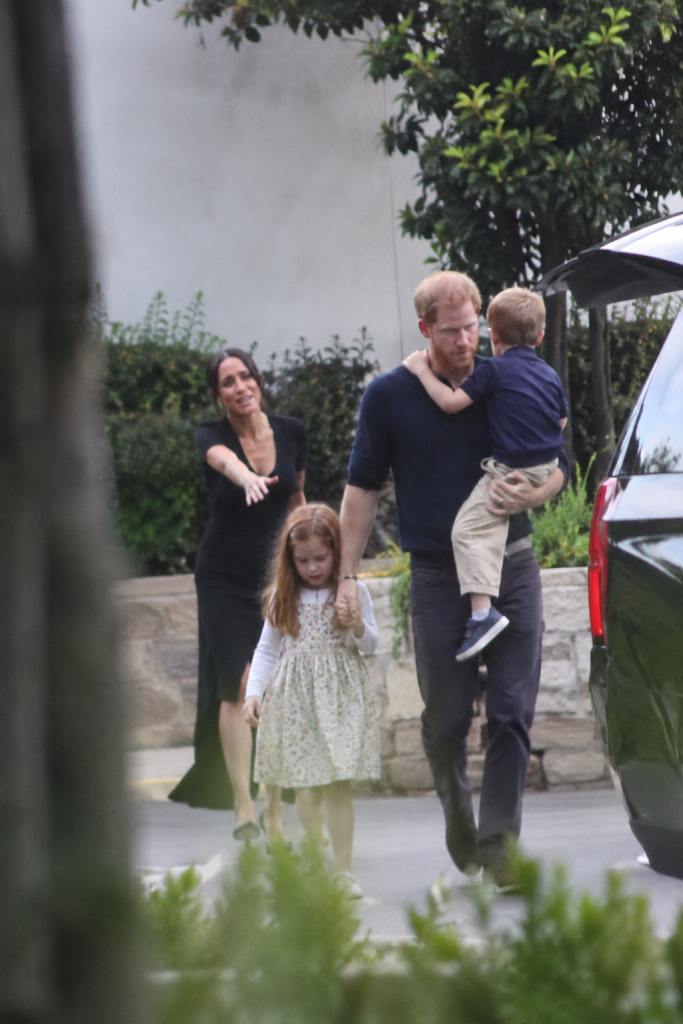
A black SUV waiting outside the family home. Two young children accompanying their father. And Meghan Markle standing several steps behind, struggling to accept a decision that could change everything. At the centre of this dramatic royal family scenario is a question with enormous personal consequences: what would drive Prince Harry to leave Montecito with Archie and Lilibet while Meghan remained behind?
For years, Prince Harry and Meghan Markle have presented their move to California as the beginning of a new chapter — one built around independence, family stability and the freedom to raise their children outside the traditional pressures of royal life.
But the possibility of Harry taking Archie and Lilibet to another residence introduces a far more complicated picture.
A family once united by the decision to leave Britain could now face a different question: what happens when the two parents disagree about the life they have built together?
The Departure That Changes Everything
The defining scene unfolds outside the family’s Montecito residence.
A dark SUV is waiting in the driveway.
Harry emerges with the children, carrying his young son while guiding his daughter toward the vehicle.
There is no public ceremony, no official announcement and no elaborate farewell.
Instead, the departure is quiet, practical and deeply emotional.
Meghan follows behind them.
Her distress becomes increasingly apparent as Harry continues toward the waiting vehicle.
She reaches out, attempting to persuade him to reconsider.
Harry pauses briefly but does not reverse his decision.
His attention remains focused on the children and the journey ahead.
The most striking detail is not the waiting car or the luggage.
It is the physical distance between the parents.
Only a few steps separate them, yet their disagreement has created a divide that appears much harder to cross.
What Happened Before Harry Walked Away?
The confrontation begins with a disagreement over how the family should move forward.
Harry has become increasingly concerned about the pressures surrounding their household.
Their lives in California have provided greater independence from royal institutions, but that independence has not eliminated public scrutiny.
Every appearance, business venture and family decision continues to attract attention.
For Harry, the question is how to create a more predictable environment for Archie and Lilibet.
He believes the children need a routine that is not continually influenced by public expectations.
Meghan sees the situation differently.
She believes their family has already made enormous sacrifices to establish a life in California.
Leaving the family home, even temporarily, threatens the stability they worked to create.
Their disagreement is not simply about an address.
It is about what stability means.
For Meghan, remaining together in Montecito represents continuity.
For Harry, a temporary change of environment represents an opportunity to reduce tension.
Neither position is without emotional consequences.
But the disagreement reaches a point where Harry decides that another conversation will not resolve it immediately.
The Decision To Take The Children Somewhere Else
The central development is Harry’s decision to move temporarily to another residence with Archie and Lilibet.
The move is not presented as an international relocation.
Nor does it necessarily mean that a permanent separation has been agreed upon.
Instead, Harry chooses a quieter location where the children can continue their daily routines away from the immediate tension between their parents.
The distinction matters.
A temporary change of residence can be intended to create breathing room rather than establish a final outcome.
However, when young children are involved, even a short separation can become emotionally complicated.
Questions quickly arise about parenting arrangements, communication and the practical responsibilities shared by both parents.
Harry’s decision therefore carries consequences beyond the journey itself.
It forces the couple to confront an issue they can no longer postpone: how to manage serious disagreements without allowing them to disrupt their children’s lives.
Why Meghan Tries To Stop Him
For Meghan, the sight of Harry walking toward the SUV with both children represents more than a temporary departure.
It brings the uncertainty of their relationship into sharp focus.
The Montecito home has symbolized a new beginning for the family.
It represents their independence, their private lives and the future they envisioned after stepping back from royal duties.
Watching Harry leave with Archie and Lilibet challenges that vision.
Her immediate concern is the separation from the children.
She wants the disagreement resolved before anyone leaves.
Harry, however, believes that remaining in the same environment will only prolong the confrontation.
This creates the emotional contradiction at the centre of the encounter.
Meghan wants the family to stay together while they work through the problem.
Harry wants distance before attempting another conversation.
Both are responding to the same crisis, but their chosen solutions pull them in opposite directions.
The Moment Harry Refuses To Turn Back
The encounter reaches its most painful point beside the waiting vehicle.
Harry stops and turns toward Meghan.
For a brief moment, there is an opportunity for the departure to be reconsidered.
But the conversation does not produce an agreement.
Harry maintains his decision.
He guides the children toward the vehicle and prepares to leave.
Meghan remains behind, visibly overwhelmed.
The departure becomes a symbolic turning point because it transforms a private disagreement into a physical separation.
Until that moment, the argument has been about what might happen.
Once Harry reaches the vehicle, the consequences become immediate.
The children are leaving with their father.
Meghan is remaining at the house.
And the next stage of the family’s life is suddenly uncertain.
Why Archie And Lilibet Are At The Centre Of The Conflict
Archie and Lilibet are not merely accompanying characters in this family dispute.
Their welfare is the most important consideration.
Both children have spent their formative years in an environment shaped by unusual public attention.
Harry has frequently discussed the difficulties of growing up under intense media scrutiny.
His concerns about protecting his family are closely connected to his own childhood experiences.
Meghan has also spoken publicly about the importance of family and creating a secure environment for their children.
Those shared priorities do not guarantee agreement about every parenting decision.
Two parents can want the same outcome while disagreeing sharply about how to achieve it.
One may believe that consistency is essential.
The other may believe that temporary distance from a stressful environment is necessary.
In either case, the children’s emotional security must remain the central concern.
A responsible arrangement would require clear communication between the parents, predictable routines and careful attention to the children’s needs.
Does Leaving The Family Home Mean The Marriage Is Over?
The most dramatic interpretation of Harry’s departure is that the marriage has reached its breaking point.
But leaving a shared residence does not automatically establish that a relationship has ended.
Couples sometimes live separately while attempting to resolve serious disagreements.
The significance of such a decision depends on the circumstances, intentions and arrangements involved.
In this scenario, Harry’s departure marks a serious escalation.
It indicates that ordinary conversations have not produced a workable compromise.
However, it does not establish that divorce proceedings have begun or that either parent has surrendered responsibility for the children.
The immediate question is whether the physical separation will help reduce conflict or make reconciliation more difficult.
That uncertainty becomes the defining issue after the SUV leaves the driveway.